Website Examples

10 Therapist Website Examples & Design Ideas

Looking for inspiration for a therapist or counseling website? These real therapy websites show different ways to communicate specialties, introduce clinicians, explain telehealth and locations, clarify fees and insurance, and make the first step toward contacting a therapist feel simple.

Note: These examples are included for their website design, content, organization, and user experience. We are not evaluating or recommending the clinical care provided by any therapist or practice listed here.

Quick Take

What Makes a Great Therapist Website?

01

Clear Client Fit

Visitors should quickly understand who the therapist works with and which concerns or life situations they commonly address.

02

Real Clinician Information

Therapist photos, credentials, specialties, approaches, and personal introductions help prospective clients understand who they may be meeting.

03

Practical Details

Location, telehealth eligibility, fees, insurance, availability, and appointment format should be easy to find.

04

A Comfortable First Step

Consultation, intake, contact, or matching options should be obvious without making the site feel overly sales-driven.

Real-World Inspiration

Therapist Website Examples Worth Studying

These examples were selected because each demonstrates something different, from highly focused niche messaging and telehealth clarity to group-practice navigation, fees, therapist matching, and the in-person experience. For a more focused look at relationship practices, see our couples therapy website examples.

01

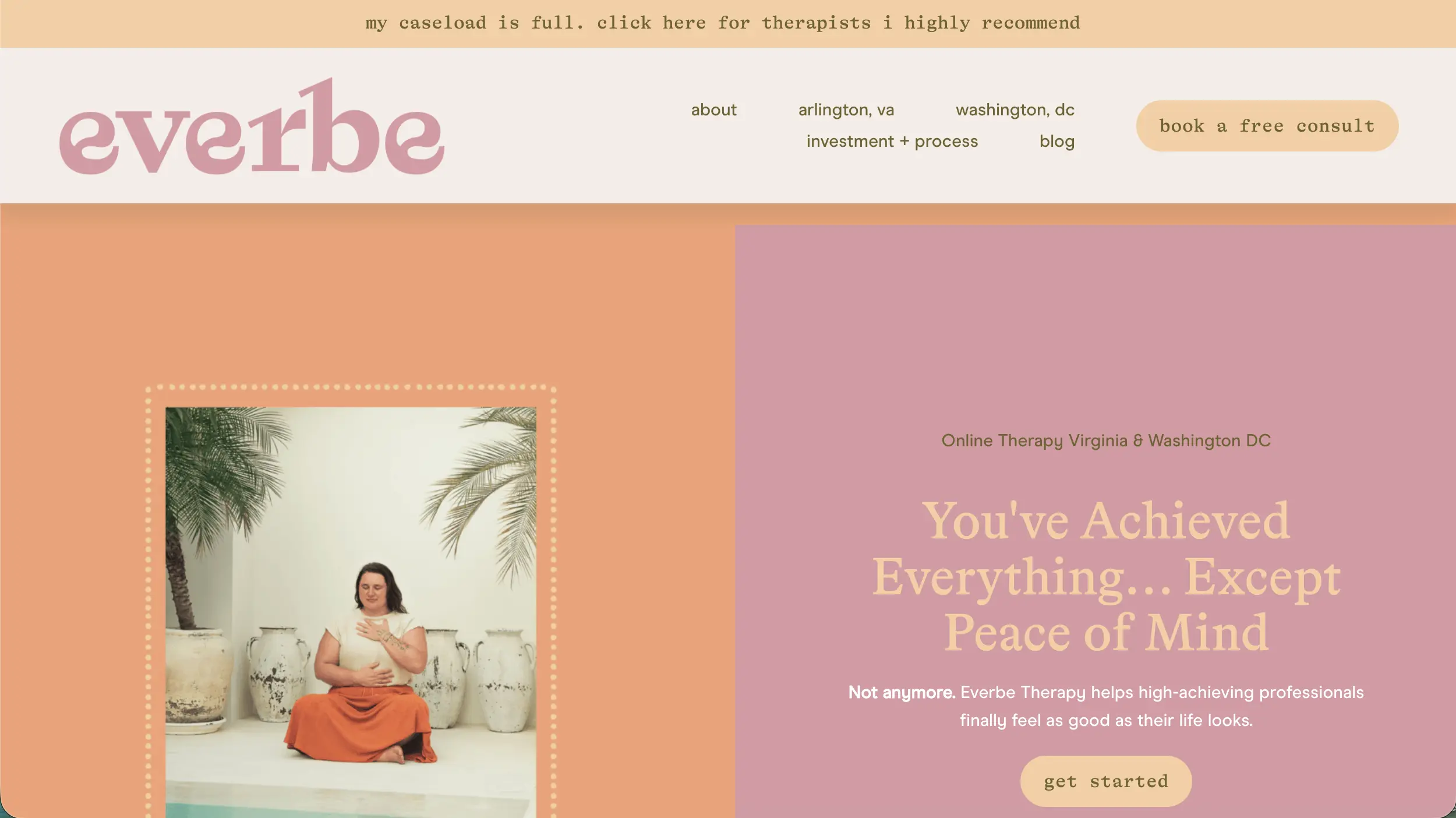
Ever Be Therapy

Online Individual Therapy

Visit Website →
Best Niche Messaging
Ever Be Therapy website homepage example
Ever Be Therapy

Why it works

Ever Be Therapy immediately communicates a specific audience rather than trying to appeal to every possible therapy client. The website identifies its online format, geographic availability, and the kinds of high-achieving professionals it is designed to help.

The copy then connects that positioning to concerns such as anxiety, perfectionism, self-criticism, and depression, while genuine therapist photography makes the practice feel more personal.

02

De la Tierra Wellness Collective

Psychotherapy & Sex Therapy

Visit Website →
Best Audience-Specific Positioning
De la Tierra Wellness Collective website homepage example
De la Tierra Wellness Collective

Why it works

De la Tierra makes its intended audience and therapeutic perspective visible immediately. The homepage explains who the practice is designed to support rather than depending on broad phrases that could appear on almost any therapist site.

Psychotherapy, sex therapy, telehealth, and geographic availability are also easy to understand, so visitors can evaluate both fit and logistics quickly.

03

Child & Family Therapy Collective

Child, Family & Assessment Services

Visit Website →
Best Family Practice Navigation
Child and Family Therapy Collective website homepage example
Child & Family Therapy Collective

Why it works

This practice has a more complicated information architecture than a solo therapist site because it offers therapy, parent and family services, groups, speech and language services, and several forms of testing.

The site keeps those options understandable by organizing around the kinds of help families may be seeking rather than expecting visitors to understand the practice's internal structure.

04

Self Embrace Therapy

Virtual Therapy

Visit Website →
Best Teletherapy Location Clarity
Self Embrace Therapy website homepage example
Self Embrace Therapy

Why it works

Self Embrace makes its virtual format and geographic availability clear rather than leaving visitors to wonder whether online therapy is available where they live.

The practice's positioning, services, FAQs, consultation path, and existing-client resources are also clearly separated, helping prospective and current clients reach the right information.

05

Human Nurture Counseling

Perinatal & Family Therapy

Visit Website →
Best Specialty Organization
Human Nurture Counseling website homepage example
Human Nurture Counseling

Why it works

Human Nurture is built around a clearly defined life stage rather than an extremely broad list of mental-health concerns. The practice focuses on new and expectant parenthood and then organizes its services around related situations.

Prenatal therapy, postpartum therapy, birth trauma, couples work, groups, location, remote availability, and an introductory-call option create a clear path through that specialty. For more relationship-focused inspiration, see our couples therapy website examples.

06

Dr. Chandler Puhy

Therapy, Testing & Evaluation

Visit Website →
Best Therapy vs. Assessment Clarity
Dr. Chandler Puhy therapist website homepage example
Dr. Chandler Puhy

Why it works

This website distinguishes therapy from testing and evaluation immediately. That's useful because someone seeking a psychological assessment may have a very different goal from someone looking for recurring therapy.

Services, fees, FAQs, educational information, and contact details remain accessible without turning the site into a complicated directory.

07

Grace Therapy & Wellness

Group Therapy Practice

Visit Website →
Best Group Practice Intake Experience
Grace Therapy and Wellness website homepage example
Grace Therapy & Wellness

Why it works

Grace Therapy & Wellness gives prospective clients a concrete intake action rather than simply presenting a large directory of clinicians. Individual, relationship, and family therapy are clearly separated.

The site also surfaces locations, specialties, insurance and payment information, and the fact that arrangements can vary among clinicians. That makes the group-practice structure easier to understand.

08

Songbird Counseling Services

Teletherapy

Visit Website →
Best Fees & Insurance Transparency
Songbird Counseling Services therapist website homepage example
Songbird Counseling Services

Why it works

Songbird demonstrates that a useful therapist website does not have to be visually elaborate. It clearly explains its teletherapy format, geographic availability, session fee, sliding scale, and insurance arrangement.

Those practical details answer questions that may determine whether a prospective client can realistically pursue therapy before they spend time completing an inquiry.

09

Forepoint Counseling

Individual Counseling

Visit Website →
Best In-Person Experience Preview
Forepoint Counseling therapist website homepage example
Forepoint Counseling

Why it works

Forepoint puts the individual therapist at the center of the website, making it easy to understand who the prospective client may be working with, along with specialties, credentials, and therapeutic approach.

Showing the physical counseling environment also gives in-person clients more context about what arriving for an appointment may actually feel like.

10

Authentic Connections Therapy & Wellness

Multi-Therapist Group Practice

Visit Website →
Best Consultation & Matching Flow
Authentic Connections Therapy and Wellness website homepage example
Authentic Connections Therapy & Wellness

Why it works

Authentic Connections offers many specialties and clinicians, but the site reduces the burden on the visitor by explaining a consultation and therapist-matching process.

Multiple locations, virtual options, specialties, and the free consultation are organized around a simple progression: make contact, get matched, and begin therapy.

What We Learned

What the Best Therapist Websites Have in Common

Strong therapist websites help prospective clients understand fit, logistics, and the next step without making a sensitive decision feel like an aggressive sales process.

Clear Client Fit

Explain who the practice commonly works with and the kinds of concerns, life stages, or relationships it is designed to support.

Real Therapist Information

Photos, credentials, specialties, therapeutic approaches, and personal introductions help visitors understand who they may be meeting.

Location & Telehealth Clarity

Make office locations and telehealth availability easy to understand, including the states or regions where virtual services are offered.

Fees & Insurance Information

Session fees, insurance participation, sliding-scale availability, and payment expectations can be important practical filters for prospective clients.

Easy Specialty Navigation

Individual therapy, couples work, family therapy, testing, groups, and specialty services should be clearly separated when a practice offers several types of care.

A Low-Friction First Step

Consultation, contact, intake, or therapist-matching options should be visible without creating pressure or overwhelming the visitor.

Building Your Own?

How to Build a Therapist Website Like These

You don't need to copy one of these sites. Borrow the ideas that fit your practice: clear positioning, genuine therapist information, easy-to-understand services, transparent logistics, and a comfortable path toward making first contact.

1

Clarify Who You Help

Make it easy for the right prospective client to recognize your specialties, audience, and approach.

2

Introduce the Therapist

Use real photos, credentials, specialties, and approachable biography content to help visitors understand who they may work with.

3

Explain the Logistics

Location, telehealth availability, fees, insurance, appointment format, and policies should not be unnecessarily difficult to find.

4

Simplify the First Contact

Give visitors a clear way to request a consultation, complete intake, contact the practice, or get matched with a clinician.

Before You Launch

Therapist Website Checklist

Use this as a quick starting point when building or reviewing a therapist or counseling website.

Target clients and specialties are clear
Therapist names, photos, and credentials are visible
Individual, couples, family, group, or testing services are clearly separated
Office location is easy to find
Telehealth availability and eligible locations are explained
Fees or insurance information is available where appropriate
Consultation, intake, or contact path is easy to find
Existing-client resources are separated from new-client actions
Privacy and crisis-related boundaries are communicated appropriately
The entire website works well on phones

Frequently Asked Questions

Therapist Website Design FAQs

What should a therapist website include?

A therapist website should clearly explain who the therapist works with, specialties, services, credentials, location, telehealth availability, contact or intake options, and practical details such as fees or insurance where appropriate.

Should therapists show their fees online?

Showing session fees or explaining how pricing works can help prospective clients determine whether the practice is financially realistic for them before making contact. Practices can also explain insurance, sliding-scale availability, or out-of-network policies where relevant.

Should therapist websites use real photos?

Real clinician and office photography can help prospective clients understand who they may meet and what an in-person environment looks like. Authentic photos often provide more useful context than generic wellness stock imagery.

What should an online therapist website say about location?

Virtual practices should clearly state where services are available. Visitors should not have to search extensively to determine whether the therapist provides telehealth to clients in their state or region.

What is a good call to action for a therapist website?

Common options include requesting a consultation, contacting the practice, beginning intake, or asking to be matched with a therapist. The best choice depends on how the practice actually handles new clients and should accurately reflect what happens next.